


‘Being a Lawyer Is About Helping Build What Comes Next.’

Like at least some of the law students in her audience, Cheree McAlpine’s earliest impressions of lawyers came directly from television courtroom dramas. In fact, the first time that McAlpine—who grew up in a small town in rural Alabama—actually met a lawyer was when she enrolled at Suffolk University Law School.
Today McAlpine, JD ’96, is the chief legal officer for Zoom, and in her Commencement remarks to Suffolk Law’s Class of 2026, she described how working as a lawyer often looks nothing like it does on television—and also how compelling and personally satisfying the actual practice of law can be.
“On TV, being a lawyer means dramatic courtroom entrances, profound cross-examinations delivered without notes, closing arguments so powerful that sometimes even the jury cries.”
“In reality, [law] is about precision,” she said. “What will define you is how carefully you work, how honestly you respond, and how seriously you take the impact of what you’re doing.”
McAlpine was awarded an honorary Doctor of Laws degree at the Law School ceremony, one of three Suffolk commencements held at Boston’s Leader Bank Pavilion on Sunday, May 17.
‘Being a lawyer is not about sitting on the sidelines’
For starters, she said, television doesn’t prepare you for how much of the legal profession involves writing.
“Not dramatic closing arguments or last-minute motions delivered in a packed courtroom, but emails. Endless correspondence. Carefully worded updates,” she said. “You will write briefs that nobody claps for. Contracts nobody reads closely until something goes wrong. Memos that exist solely to help someone else make a decision.”
At its core, the practice of law is, she said, “a service profession,” and one that demands the ability to listen closely to clients. “When people feel truly heard, they begin to trust you, and that trust is often the foundation for everything that follows.”
For McAlpine, what followed her graduation from Suffolk Law was a move to Silicon Valley, “at a time when the internet was no longer an experiment but a force reshaping the world.”
McAlpine said that “grappling with how technology should evolve and how it should be governed” has only deepened her love for the law, and her belief that “law is not a constraint on innovation, but part of its core foundation. Being a lawyer is not about sitting on the sidelines—it’s about rolling your sleeves up, getting in there, and building what comes next.”

‘Change does not only happen in courtrooms’
Graduate speaker Crystin Mueller, JD ’26, recalled how she and her classmates got an early taste of what it means to think like a lawyer during their first days at Suffolk Law. Faced with the foundational legal question, “What is a dwelling?” they learned that the answer to this (and many subsequent legal questions) is: “Well, it depends.”
That legal uncertainty, she told her classmates, became something steadier over time: a shared sense of purpose shaped by long nights, cold calls, and the community they built together. She described the graduating class as individuals with hundreds of stories: “Students who are also parents, moving between kitchens and classrooms and casebooks and bedtime routines,” and “children of immigrants carrying with them not only their own ambitions, but the sacrifices, hopes, and courage of those who came before them.”
When those graduates are confronted with something that doesn’t sit right, she told them, “You always have a choice. You can dissent.”
But that dissent, she emphasized, doesn’t have to begin in court. “Change does not only happen in courtrooms, because it starts much smaller than that. It starts in how we treat people. In how we listen. In how we show up for our communities, for our clients, and for each other. It starts with basic kindness.”
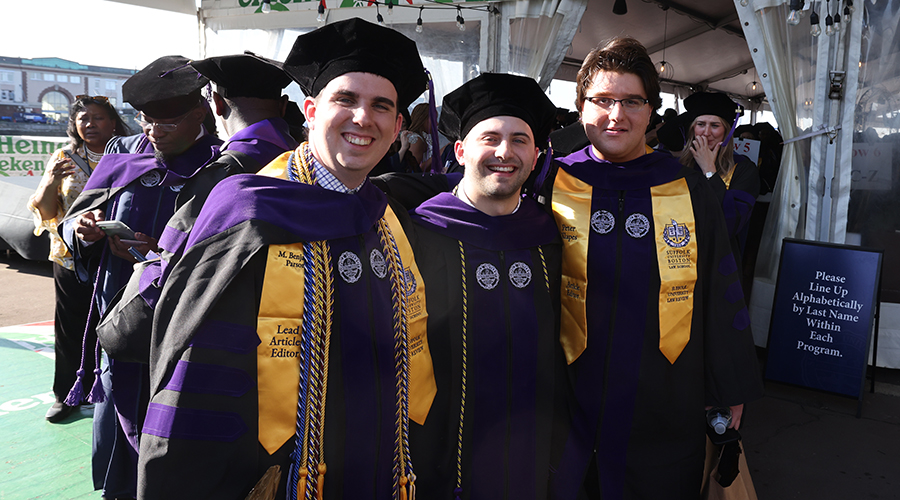
Suffolk University Law School Class of 2026 comprises 387 new alumni.
‘A humanity-first approach’
Suffolk University President Marisa Kelly celebrated the graduates for being “deeply responsive to societal challenges,” while contributing approximately 55,000 hours of legal representation through the Law School’s 15 clinical programs, service with a value conservatively estimated at nearly $7 million.
She noted those clinical programs received their highest US News ranking ever this year, at No. 4 nationally. “When you look at what you all are doing, it’s easy to understand why,” she said, adding that they had focused on “helping people who need it most, while defending core legal principles and expanding access to justice.”
She praised the students for taking a “humanity-first approach that uses technology to provide greater access to justice,” and described one of the graduates in the audience, a Coast Guard veteran, who used skills he learned in Suffolk Law’s Legal Innovation & Technology Clinic to build an online platform that connected more than 2,000 veterans and military families with benefits they might not have realized they had earned. Other students, she added, created a web app that walks people through appealing a MassHealth coverage denial, whether for an insulin injection, heart surgery, or the right to enroll at all.
“You represent the very best of what this institution stands for,” Kelly told the graduates. “You have served tirelessly with forward-looking approaches, and led with humanity and empathy. I believe that will not only serve you well—it will serve the world well.”
A futurist asks graduates to look back
Dean Andrew Perlman, known nationally for legal innovation and for keeping his eye trained on the future, told graduates to look backward, and reflect on what first drew them to pursue a law degree.
As their legal education unfolded and their focus shifted to passing the bar and finding jobs, Perlman urged the graduates to stay grounded. “Don’t forget your sense of purpose. Your personal precedents—they should guide you going forward,” he said.
In his 11 years as dean, Perlman said he had missed Commencement only once—last year, when two of his children graduated from college the same weekend. The event reminded him how easily the demands of a legal career can crowd out what matters most.
“Don’t let those responsibilities and your drive distract you from being there for the people who got you to this moment,” he said. With one important exception: “This summer, when I know you’ll all be giving your undivided attention to the bar exam. I’m only kidding. Sort of.”

About Cheree McAlpine, JD ’94
Cheree McAlpine, JD ’94, brings more than 25 years of global legal leadership in the technology sector to her role as chief legal officer at Zoom, where she plays a key role in helping the tech company grapple with the lightning pace of technological change.
She joined the company in 2024 and oversees a worldwide team responsible for commercial, product compliance, privacy, and regulatory matters, guiding Zoom through complex issues such as AI governance, global data regulation, and user trust and safety.
Previously, she served as senior vice president and general counsel at Intercom and held executive legal roles at Lumileds Inc., Avnet Americas, and Wyse Technology, where she managed the company’s successful sale to Dell. She was named one of Savoy Magazine’s Most Influential Lawyers in Corporate America (2024) and one of the Top 100 Diverse Leaders in Technology (2022) by the National Diversity Council.
McAlpine earned her law degree from Suffolk University Law School and her BA in English from the University of Alabama.
Commencement 2026
Suffolk University Law School Class of 2026 comprises 387 new alumni.
The ceremony was one of three Suffolk Commencements held on Sunday, May 17, at Boston’s Leader Bank Pavilion. The University conferred a total of 2,066 undergraduate and advanced degrees to graduates from 42 states and 62 different countries. Thirty-four percent of Suffolk’s 1,161 undergraduate degree recipients are first-generation college students.
Photo Gallery and Video of the Full Suffolk Law School Commencement
Media Contact
Greg Gatlin
Office of Public Affairs
617-573-8428
[email protected]