


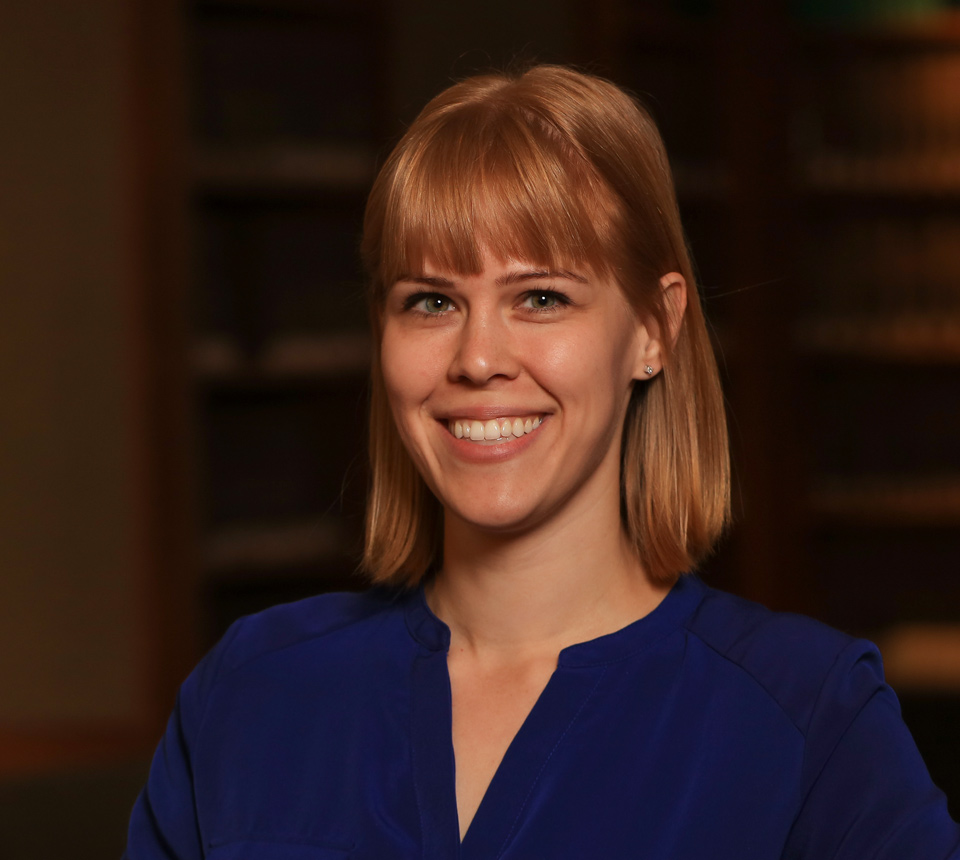
Kelsey Stocker, PhD
Associate Professor, Chemistry & Biochemistry; Chair of Biochemistry, Chemistry, Environment & Physics
Send a MessageEducation
Research Interests
As a computational physical chemist, I use computer simulations to model chemical systems and provide new insights into the properties and behavior of these systems. I am particularly interested in the chemical reactions and phenomena that occur at interfaces or in complex materials.
Teaching Philosophy
My teaching philosophy is centered on active learning strategies that build confidence and competence. I believe students learn best in collaborative learning environments where they can engage in genuine inquiry. As a first-generation college student myself, I am committed to making all levels of chemistry accessible and inspiring to every student in my classroom or research group.
Professional Affiliations
- Member of the American Chemical Society
Grants, Honors, Awards, and Recognitions
- $50,000, NASA: Investigation of Surface Films as Reservoir for Volatile Methylsiloxane SVOCs (2025-2026)
- $49,946, NASA: Formation of Secondary Organic Aerosols via Oxidation of Volatile Methylsiloxanes (2023-2025)
- $98,209, NASA: Computational Investigation of Dimethylsilanediol Production from Volatile Methylsiloxanes and Hydroxyl Radicals in the International Space Station Atmosphere (2019-2021)
Recent Scholarly Contributions
- Stocker, K. M. (2025). Modeling the fate of oxidized volatile methylsiloxanes. Proceedings of the 54th International Conference on Environmental Systems.
- Stocker, K. M., Jin, H.*, & Lee, H.* (2024). Estimating physical properties of oxidized volatile methylsiloxanes. Proceedings of the 53rd International Conference on Environmental Systems.
- Drisko, C. R., Bhattarai, H., Fennell, C. J., Stocker, K. M., Vardeman, C. F. II, & Gezelter, J. D. (2024). OpenMD: A parallel molecular dynamics engine for complex systems and interfaces. Journal of Open Source Software, 9(103), 7004.
- Stocker, K. M. (2019). Using electronic structure calculations to investigate the kinetics of gas-phase ammonia synthesis. In A. Grushow & M. S. Reeves (Eds.), Using computational methods to teach chemical principles (pp. 21-32). American Chemical Society.
*Denotes a Suffolk University undergraduate co-author
Contact Me
- 617-573-8254
- [email protected]
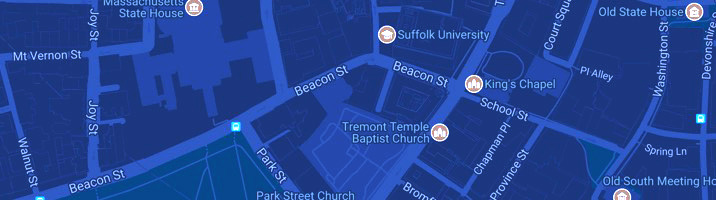
- 20 Somerset Street, 8th Floor, Room 827
Office Hours
- Schedule an Appointment
Monday 9:00 a.m. - 10:30 a.m. (in-person)
Thursday 9:00 a.m. - 10:30 a.m. (in-person)
Courses Taught
- CHEM-411/L411 Quantum Chemistry and Spectroscopy
- CHEM-412/L412 Thermodynamics and Kinetics
- CHEM-375 Advanced Inorganic Chemistry
- CHEM-L111 General Chemistry Laboratory I
- SCI-104 Food Chemistry