

Digital Credentials

Suffolk University’s Digital Credentials Program provides a vital framework for showcasing your skills.

Digital credentials represent your mastery of specific competencies and skills, highlighting your career-ready capabilities. Each undergraduate and graduate credential is crafted to match industry standards and real-world workforce needs.

By earning digital credentials at Suffolk, you demonstrate your commitment to professional growth while building a verified portfolio of attention-grabbing achievements that set you apart in today’s competitive job market.
Microcredential Levels

Suffolk offers three main types of digital credentials at the undergraduate and graduate levels:

  • Academic: A three-tiered credential system—Fundamental, Intermediate, and Advanced—that recognizes progressive levels of mastery of core class-related competencies
  • Career: Demonstrates competency in specific professional areas and technical proficiencies
  • Co-curricular: Indicates achievements and skills developed beyond the classroom

Each credential recognizes distinct achievements and competencies, allowing you to display your comprehensive development on platforms such as LinkedIn.

We also offer Skill credentials, showcasing mastery of a particular skill, such as Python.


Example Badges:

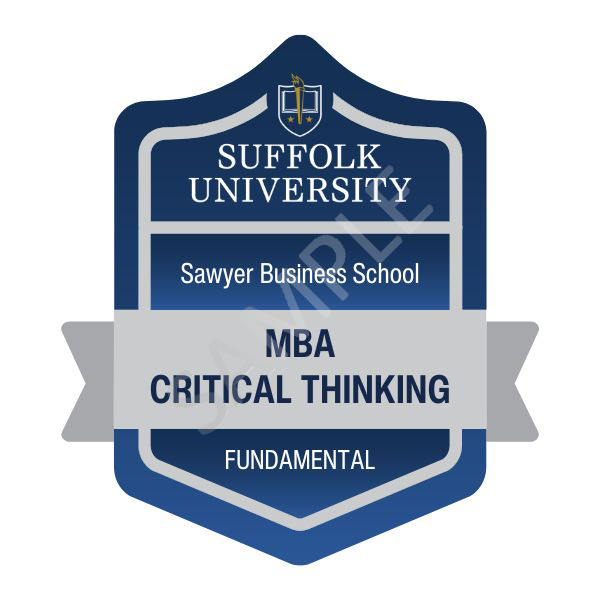
MBA Fundamental Critical Thinking Badge from Suffolk University's Sawyer Business School
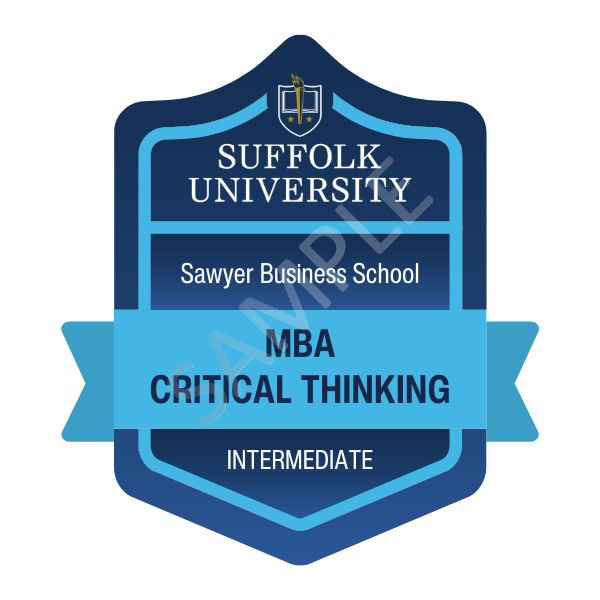
MBA Intermediate Critical Thinking Badge from Suffolk University's Sawyer Business School
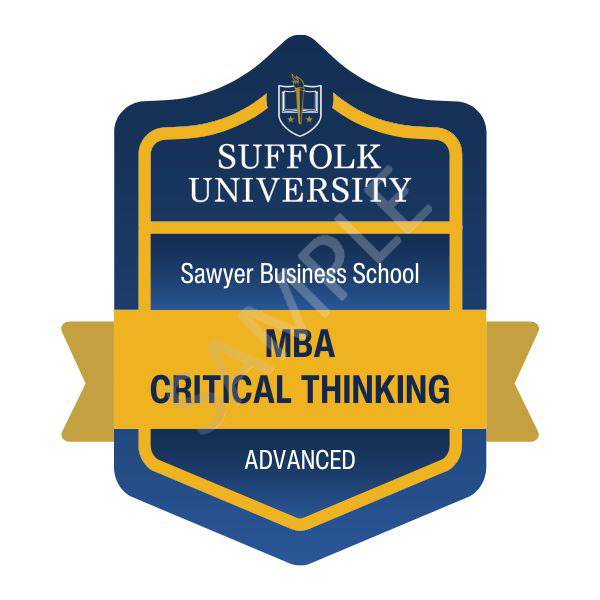
MBA Advanced Critical Thinking Badge from Suffolk University's Sawyer Business School

Credentials are available at both the undergraduate and graduate levels.


Dave Merry, Associate Provost and Executive Director of Suffolk University's Center for Career Equity, Development & Success

“Credentialed competencies help students stand out in today’s competitive job market by highlighting the skills employers value most. These University-endorsed credentials don't just showcase students’ abilities, but also accentuate the unique, personalized way a student has developed those skills.”

Dave Merry, Associate Provost and Executive Director
Center for Career Equity, Development & Success

Resources & Guides

Claiming a digital credential is a simple process.

Academic credentials are earned as part of a pathway of learning: The series of steps a student takes to learn a particular competency. You'll earn a credential by completing the requisite steps in the pathway associated with your program competencies, such as a course completion with a particular grade or an activity such as a case competition.

Career, Co-Curricular, and Skills credentials are earned by successfully completing a workshop or course.

Share your credentials on social media or incorporate them into your resume or website to spotlight your skills and competencies.

Through our partner, Canvas, multiple sharing avenues are available including:

  • LinkedIn
  • Facebook
  • X
  • Email
  • Embed in a website
  • Add to an electronic resume

Faculty/Staff Credential Proposal Process

Faculty and staff members can propose new credentials through a straightforward process:

  1. Identify competencies to measure in your program or course
  2. Consult with your associate dean to determine specific requirements
  3. Complete the credential proposal form
  4. Submit for review and approval