



MS in Criminal Justice


Full-Time


Part-Time


30 Credits

Justice in our communities is far more than just arrests, convictions, and exonerations. It’s a complex ecosystem touching on education, corrections, youth programs, mental health care, drug rehabilitation, and much more. Suffolk’s Master of Science in Criminal Justice (MSCJ) program will help you navigate the intricacies of the criminal justice system and empower you to make a difference.

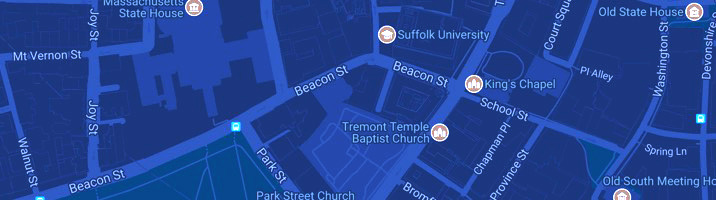
Our dynamic, pragmatic program—located steps away from municipal and federal courts and critical community-based organizations—prepares you to tackle real-world challenges and devise tangible strategies to enhance community well-being and public safety.

As a student in Suffolk’s MS in Criminal Justice program, you will:

  • Identify alternative, community-based responses and interventions to crime and disorder
  • Assess how other social processes and institutions beyond the criminal justice system affect crime and crime control
  • Develop strong communication skills that can adapt to a variety of audiences and research products, such as scholarly papers, policy briefs, grants, reports, and presentations
  • Become a more critical media and research consumer who interrogates data presentation, source biases, and the representation of the criminal justice system
  • Learn from research-active faculty who bring their experiences into the classroom and provide opportunities for student involvement in projects

Request Information

Note: Graduate students who began the program before Fall 2026 will graduate with a Master of Science in Crime & Justice Studies, while students enrolling Fall 2026 or later will pursue a Master of Science in Criminal Justice.

Success after Suffolk

Here's a sampling of recent graduates’ current job titles and employers.

Assistant Deputy Director, Youth Options Unlimited Program
City of Boston
Program Coordinator
Commonwealth of Massachusetts
Policy Analyst
Crime and Justice Institute
Court Assistant
New Hampshire Judicial Branch
Probation Support Technician
United States Courts
Family Services Case Manager
Westbay Community Action
Clinical Supervisor
Youth Villages
Executive Director
Reading Housing Authority
CREW Instructor & Case Manager
Massachusetts Office for Victim Assistance
Director of Public Affairs
Massachusetts Senior Care Association
Commissioner to Qualify Public Officers
Commonwealth of Massachusetts

MSCJ Program Overview

Our experiential curriculum is designed to help students critically assess criminal justice policies and practices from intersectional perspectives. You’ll apply academic theories of crime to real-world problems, moving beyond a theoretical understanding of crime and victimization to identify successful intervention models and strategies that promote community health and safety. In addition, you’ll develop the skills to produce a variety of communications—from scholarly writing to more public-facing pieces like presentations, grants, policy briefs, and short reports—that are critical to bridging the research-practice gap and fostering community relations.
View the MSCJ curriculum

Requirements

Core Requirements 12 Credits (4 Courses)
Electives 18 Credits (6 Courses)
Total 30 Credits (10 Courses)


Real-World Flexibility

The majority of MSCJ courses meet on campus Monday through Thursday after 5:00 pm, allowing our graduate students to pursue internships and careers during traditional business hours. Learn more about recent internship sites under Strategic Partnerships.


Additional Student Opportunities

The Sociology & Criminal Justice Department awards a program fellowship every year to help defray the cost of graduate school in exchange for eight hours of work per week. All enrolled MSCJ students may apply for this position by emailing their resume to Professor Rebecca Stone by August 1 of any given calendar year. A candidate will be selected before the fall semester begins, and the candidate will serve as MSCJ Fellow for both the fall and spring semesters.

Eligible students can join Alpha Phi Sigma, the national criminal justice honor society. Graduate students must have completed four courses in criminal justice, have a minimum GPA of 3.4, and be in the top 25 percent of their class. The Alpha Phi Sigma induction ceremony takes place in April or early May each academic year.

Advising & Other Resources

Our Graduate Student Services team is here to support you every step of the way. From application advising to financial aid counseling and international student resources, we provide a wide range of services to help you get the most out of your education. You’ll also have the opportunity to participate in professional development workshops throughout the year, as well as lifelong access to all of the tools and resources offered by our Center for Career Equity, Development & Success.


Strategic Partnerships

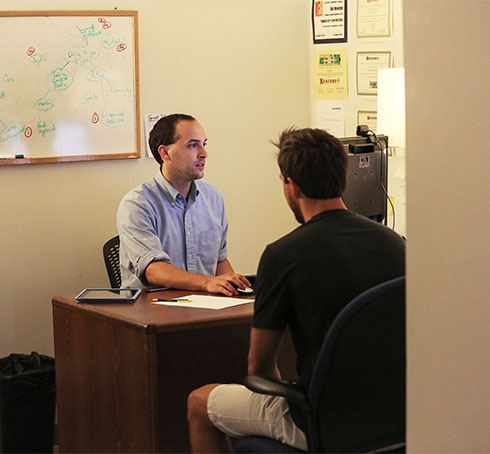
Student meets with an internship advisor

Internships can help you expand and refine your career objectives. The optional graduate internship is a one- or two-semester (3 credits per semester) placement in a criminal justice-related agency. Placements can range from advocacy to law enforcement agencies to penal institutions, including:

  • Local and State Nonprofits
  • County and Superior Courts
  • Prisoner Education Network
  • Massachusetts Correctional Legal Services
  • Suffolk County District Attorney
  • Office of the Commissioner of Probation
  • Boston Alcohol & Substance Use Programs
  • State Youth Justice agencies
  • State and Federal Law Enforcement agencies

Interested students must have a minimum GPA of 3.0 and meet with the director the semester prior to placement. To start the process contact Professor Donna Cole.

Three women talk at the Decarcerating Women Today event

Our department’s Center for Women’s Health & Human Rights strives to advance the health and human rights of women and girls everywhere through advocacy, education, research and leadership. We encourage you to get involved by attending events, volunteering, and making an impact through research and work on initiatives, including:

  • Our Bodies Ourselves Today, which continues the legacy of the iconic books by generating, curating and delivering trustworthy and inclusive evidence-based information to women, girls and gender-expansive people.
  • The Women and Incarceration Project, a group of Boston-based academics, attorneys and social workers who research and write about the costs and harms of incarcerating women.
  • The Women’s Writing Circle, to honor and support the diverse voices of all women.

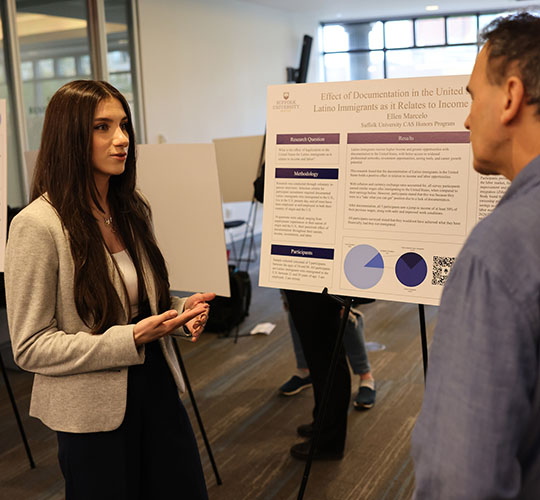
Student presents research at conference

Don’t wait until after graduation to make a difference. Our students work side-by-side with faculty on innovative research, and with outside organizations on projects that have direct community impact. You’ll also have the chance to conduct independent research and present your findings at conferences. So get involved and help address complex challenges like:

CRJ staff (front row, from left) Associate Director Carl Steidel, Founder Carolyn Boyes-Watson, Director Susan Maze-Rothstein; (back row, from left) Instructor Dana Thorsen, School Implementation Manager Ashley-Rose Salomon, Instructor Delinda Passas. Photographs by Michael J. Clarke.

Restorative justice is a community-centered practice in which equitable communities are built, sustained and maintained and when things go wrong in communities victims, offenders, and stakeholders come together to address and repair harm.

The Center for Restorative Justice at Suffolk University fosters collaborative partnerships to support a growing social movement to build just and equitable communities and to institutionalize restorative approaches to problem-solving, harm and violations of legal and human rights. Since 1997, the Center has served as a regional, national and international thought leader in restorative justice policy and practice development.

As a student in our program, you’ll have the opportunity to learn from restorative justice practitioners in the classroom and through programming on campus and in the community.

Applying to Suffolk’s MSCJ Program

Application Deadlines

  • Fall Semester: June 15 (International Applicants), August 15 (Domestic Applicants), then rolling
  • Spring Semester: December 1 (International Applicants), January 4 (Domestic Applicants), then rolling

Learn more about the advantages of priority applications.

Application Materials

  • Completed application
  • $50 Application Fee (waived for students who visit campus)
  • Resume
  • Goal Statement (essay)
  • Two letters of recommendation (learn more)
  • Unofficial transcripts of all post-secondary work. Admitted students enrolling in the program will need to have official transcripts, including proof of degree conferral, on file prior to their first class
  • Official TOEFL, IELTS, Duolingo, or PTE-Academic Scores (international students only)

View details about application materials required.

Tuition & Investment

Beginning Fall 2026, the MS in Criminal Justice program is offered at a single, transparent tuition rate of $1,000 per credit.

This intentionally designed pricing model allows you to know the full cost of your degree from the start, without variable rates or competitive merit awards, so you can focus fully on your academic and professional goals. This approach ensures exceptional value while supporting the program’s emphasis on applied learning, experiential opportunities, and career-relevant preparation in the criminal justice field.

Cost of Graduate Study at Suffolk

View current tuition and fees for this program

Financial Aid for Graduate Study

Suffolk University is pleased to offer merit-based financial aid to graduate students—these awards can be up to $14,750 per academic year. Merit-based aid is awarded based on the applicant's academic credentials presented on the admission application. No separate application is required for merit consideration.

View estimated cost of attendance

Meet the MSCJ Faculty

What's going on in Criminal Justice?


Criminal Justice Information Request

Loading...