



A First Year Student Continues Her Education Journey During Summer Internship
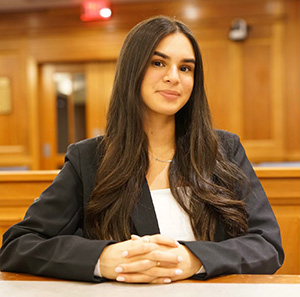 At a young age, Anusha Memon knew that she wanted to pursue a career of advocacy. While in high school, she volunteered at the Connecticut Coalition Against Domestic Violence, and subsequently continued to grow her passion in victim advocacy as an undergraduate at Quinnipiac University. There, she volunteered on the Connecticut sexual violence hotline, providing crucial support to victims. Enrolling at Suffolk Law for the Class of 2027, she knew she could utilize her legal education in order to support victims at a higher level.
Suffolk Law appealed to Anusha because of its urban character, diverse enrollment, and relatively small classes. She also had heard that the faculty were highly approachable, which was affirmed upon her matriculation. “I’ve never encountered a faculty member,” Anusha remarks, “who doesn’t want you to succeed in every possible way.” She aims to be a prosecutor in the Suffolk County District Attorney’s office, where she will be interning this upcoming spring semester in the Domestic Violence and Sexual Assault Unit.
Through the First Year Summer Internship Program (FYSIP), Anusha worked for The Honorable Judge Michelle Yee, JD ’01 at the Essex County Family and Probate Court in Salem, MA. Before coming to Suffolk, Anusha had been drawn to family law, so this internship opportunity stood out to her. She points out that family court can be a difficult experience for those involved in the litigation. Cases may entail emotionally charged issues, such as contested divorces, child custody, and child support. Many people involved in the hearings lack legal representation and adequate knowledge of the process, adding an additional burden on the parties.
Anusha’s internship was made possible, in part, by a travel allowance provided by the Karen Frankel Blum, JD ’74 First Year Summer Internship Program fund, which largely covered the cost of her daily train commute from Boston to Salem.
Beyond observing the full range of courtroom proceedings during FYSIP, Anusha wrote five judgment documents for the court. These analyses are based on witness examination and testimony, government agency records, and other data, which help the judge assess the case and arrive at a verdict. It was gratifying, Anusha comments, “to utilize my legal knowledge and education to support individuals in difficult situations arrive at judicial outcomes that will positively impact their futures.”
For Anusha, the FYSIP experience allowed her to refine her legal research and writing skills and confirmed what she's known for a long time, that “I’m eager to practice law and make a real difference in my community."